Hello, I’m Jay, a professional observer of the Korean economy. The week of January 18 to January 24, 2026, has been a historic and volatile period for South Korea.
We witnessed the KOSPI briefly crossing the 5,000-point milestone for the first time in history, while simultaneously dealing with a surprise GDP contraction that signals deep-seated structural fragility.
Here are the Top 20 Critical Economic Headlines for this week, curated with my personal analysis to help you navigate the current “K-Economic” landscape.
South Korean Economic News 2026: Weekly Top 20 Headlines
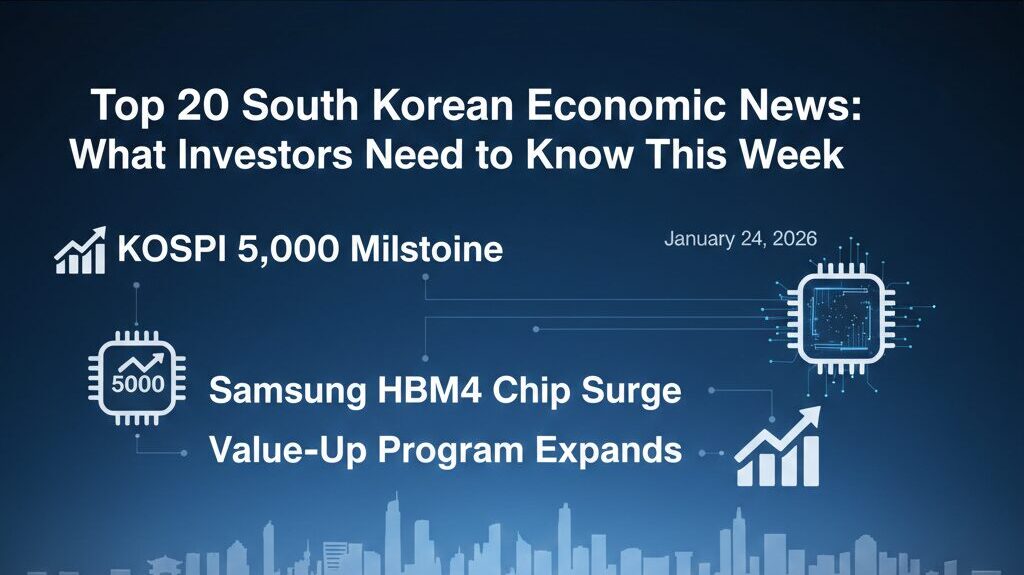
1. KOSPI Briefly Touches Historic 5,000 Mark On January 22, the KOSPI index achieved a symbolic breakthrough by touching 5,000. While it retreated slightly due to profit-taking, this milestone represents a monumental victory for the “Value-up Program.” It signals that global investors are finally beginning to re-evaluate the “Korea Discount” as companies increase shareholder returns.
2. GDP Unexpectedly Shrinks by 0.3% in Q4 In a stark contrast to the stock market rally, the Bank of Korea reported that South Korea’s GDP contracted 0.3% in the final quarter of 2025. This missed the Bloomberg estimate of 0.2% growth. This divergence between booming asset markets and a shrinking real economy highlights a fragile recovery led solely by exports.
3. IMF Raises 2026 Growth Forecast to 1.9% The International Monetary Fund (IMF) revised its growth outlook for South Korea up to 1.9% from 1.8%. While this is a positive sign, the IMF noted that this marks the fourth consecutive year that Korea’s growth trails the U.S., which is benefiting from a more aggressive AI-driven productivity surge.
4. President Lee Vows Won Stabilization at 1,400 Level President Lee Jae-myung addressed the persistent weakness of the Korean Won on January 21. He stated that authorities expect the currency to stabilize around the 1,400 per dollar level within two months. Following his comments, the won saw a 0.5% recovery, reflecting the government’s firm commitment to market stability.
5. Samsung Electronics Hits New High on HBM4 Hopes Samsung shares surged this week as reports surfaced that their HBM4 (High Bandwidth Memory) samples have successfully entered the final testing phase with major AI chipmakers. This breakthrough is seen as the key for Samsung to reclaim its leadership from competitors in the high-stakes AI infrastructure market.
6. SK Hynix Projected for Record 100 Trillion Won Profit Financial analysts have revised their 2026 earnings forecasts for SK Hynix, suggesting the company could reach a staggering 100 trillion won in operating profit. This optimism is fueled by the “AI Memory Supercycle,” where SK Hynix currently holds a dominant position in supplying premium HBM modules.
7. Household Debt Management Tightens Further Despite the economic contraction, the government has pledged to maintain strict oversight of household debt. With mortgage rates remaining elevated, officials are considering the creation of a dedicated real estate supervisory body to prevent speculative bubbles from forming amid the stock market euphoria.
8. 24-Hour Foreign Exchange Trading Fully Extended As part of the effort to gain inclusion in global bond indices, Korea has fully extended its onshore foreign exchange trading to a 24-hour system. This move is designed to attract more foreign capital by providing a seamless trading environment for investors in different time zones.
9. Semiconductor Exports Surge 22% Year-on-Year Semiconductors continue to be the sole engine of Korea’s export economy. Shipments rose by 22% this week, significantly outperforming other sectors like automobiles and steel. This heavy reliance on a single sector remains a point of concern for long-term economic diversification.
10. Government Expenditure Restructuring for AI Investment The 2026 budget focus has shifted toward a “performance-oriented” model. The Ministry of Economy and Finance announced a record-high expenditure restructuring to concentrate funds on AI and emerging industries. I see this as a necessary pivot to escape the chronic low-growth trap.
11. K-Battery Sector Rebounds on Solid-State Breakthroughs Korean battery giants saw a resurgence this week following news of trial production for solid-state batteries. After a sluggish 2025, the industry is betting on this “dream technology” to restore its competitive edge against global rivals in the 2026 EV market.
12. IMF Warns of AI Asset Price Correction Risks While raising growth forecasts, the IMF warned that the concentration of investment in a few AI firms could lead to a sharp asset price correction. For Korea, whose market is heavily weighted toward AI-related hardware, this serves as a critical warning for potential volatility.
13. Private Consumption Growth Slows to 0.3% Reflecting the 0.3% GDP contraction, private consumption growth slowed significantly. High interest rates are finally weighing on the Seoul consumer. From my perspective, unless domestic demand recovers, the export-led rally may struggle to sustain itself through the year.
14. Bank of Korea Maintains “Hawkish Hold” at 2.50% The BOK held its base rate at 2.50% this week. With the won still weak and inflation concerns lingering from agricultural prices, the central bank signaled that any talk of rate cuts in early 2026 is premature, prioritizing financial stability over growth.
15. K-Defense Sector Secures New European Contracts The Korean defense industry continues its global expansion, signing major contracts in Central Europe this week. “K-Defense” is increasingly being viewed as a second “K-Semiconductor” in terms of its contribution to the national export balance and strategic influence.
16. US-Korea Investment Plans Under Pressure Due to currency weakness and domestic growth concerns, Seoul has signaled it may hold off on some of the $20 billion investment vowed for the US in 2026. This reflects the difficult balancing act Korea must perform between global alliances and domestic economic health.
17. Corporate Value-up Disclosures Hit Record Numbers A record number of KOSPI 200 companies filed voluntary “Value-up” plans this week. The move toward higher dividends and treasury stock cancellations is becoming the new standard for Korean corporations, much to the delight of institutional investors.
18. Digital Won (CBDC) Pilot Expands to Retail The Bank of Korea’s CBDC (Central Bank Digital Currency) pilot saw its first major retail rollout in Seoul this week. This marks a significant step toward the “Digital Won,” positioning Korea as a leader in the global race to modernize financial infrastructure.
19. Construction Investment Falls 3.9% Amid High Costs The construction sector remains the weakest link in the Korean economy, dropping 3.9% this week. High labor costs and a cooling housing market outside of Seoul are causing a significant drag on domestic investment, offsetting gains in the tech sector.
20. Employment Growth Led by 60+ Demographic Latest labor data shows that while the unemployment rate remains low at 2.2%, the majority of new jobs are being created in the 60+ age group. This highlights the ongoing demographic challenge of an aging workforce and the lack of high-quality “youth jobs” in the traditional sectors.
💡 Jay’s Action Guide for Investors
- Monitor the 5,000 Level: Treat 5,000 as a major resistance-turned-support level. A sustained close above this will confirm the long-term “Value-up” trend.
- Focus on HBM Supply Chains: Don’t just look at the giants; the equipment suppliers for Samsung and SK Hynix are where the next hidden gems lie.
- Hedge for Currency: With the won target at 1,400, consider currency-hedged positions if you are an international investor to protect against further depreciation.
If you enjoyed this post, you might also like: