Hi, I’m Jay. Today, I want to take you on a journey through one of the most incredible economic transformations in human history.
As someone living in the heart of Seoul, I am constantly reminded that the ground I stand on was once nothing but rubble. The South Korea’s Economic Miracle is not just a success story; it is a strategic masterclass. While most nations take centuries to develop, South Korea achieved a 35,000% GDP increase in just a few decades. In this guide, I will reveal the 7 specific pillars that made this possible and what global investors can learn from them.
Introduction: Why This Miracle Matters Today
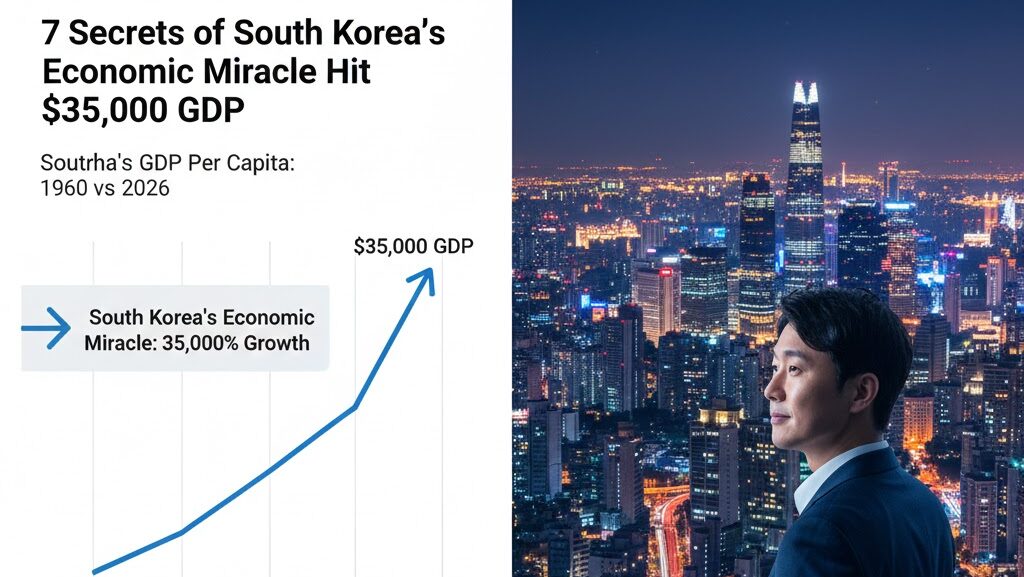
The South Korea’s Economic Miracle—often called the “Miracle on the Han River”—is the only instance in history where a recipient of international aid transformed into a major donor in such a short time. In 1960, Korea’s GDP per capita was a mere $100. Today, it stands at over $35,000.
I believe that understanding this “Korean Blueprint” is essential for anyone interested in wealth creation, national development, or high-growth investing.
My Personal Experience: The “Pali-Pali” Reality
“I’ve personally seen that growth isn’t about perfection; it’s about momentum.”
When I talk to my parents about their childhood, they describe a world without paved roads or electricity. Today, I work in a district where autonomous robots deliver coffee and 6G internet is already being tested. In my experience, the secret wasn’t just money—it was the collective psychological urgency known as “Pali-Pali” (Hurry-Hurry). I’ve seen projects that would take years in other countries be completed here in months because we simply refuse to wait. This speed is the heartbeat of our economy.
The 7 Secrets of the Miracle
1. Export-Oriented Industrialization (EOI)
South Korea realized early that its domestic market was too small for greatness. The government forced local companies to compete on the global stage from day one. If you couldn’t sell to the world, you didn’t get government support.
2. The Saemaul Undong (New Village Movement)
This was a community-driven development program that modernized rural Korea. It turned “beggars into builders” by providing cement and steel to villages that showed the most initiative.
3. Strategic Heavy & Chemical Industrialization (HCI)
In the 1970s, Korea pivoted from light textiles to steel, shipbuilding, and electronics. This “heavy lifting” created the industrial backbone that supports giants like Samsung and Hyundai today.
4. Extreme Investment in Human Capital
With zero natural resources, Korea invested everything in its people. We have one of the highest literacy and college-attainment rates globally. Education is the ultimate “wealth multiplier.”
5. National Infrastructure: The Gyeongbu Expressway
The government built a massive expressway connecting Seoul to Busan despite fierce opposition. This became the literal “aorta” of the nation, slashing logistics costs and unifying the economy.
6. The Rise of the Chaebols
By concentrating capital into large conglomerates (Chaebols), Korea created “National Champions” capable of fighting global giants in the semiconductor and automotive sectors.
7. The “Pali-Pali” Cultural Engine
This is the secret sauce. The cultural obsession with speed meant that Korea could iterate and fail faster than its competitors, eventually leading to global dominance in tech.
Quick Summary Checklist
- [ ] Global Mindset: Are you targeting the biggest possible market?
- [ ] Human Capital: Is your most valuable asset (people) being trained?
- [ ] Infrastructure: Is your “logistics” (workflow) optimized for speed?
- [ ] Pivoting: Can you move from “light” skills to “heavy” high-value skills?
Step-by-Step Action Guide for Global Readers
- Adopt the “Export” Mentality: Don’t just work for your local economy; build skills that the global market values in USD.
- Invest in Your Own “Infrastructure”: Buy the best tools and software to increase your personal “output speed.”
- Study the “Winner-Take-All” Strategy: Like Korea’s Chaebols, focus your capital and time on one “winning” niche until you dominate it.
FAQ: Common Myths About Korea’s Growth
Q1: Was it just American aid? No. While aid helped, many countries received more aid than Korea and remained poor. The difference was how the capital was invested in infrastructure and education.
Q2: Is the miracle over? The “industrial” miracle is over, but the “cultural” and “digital” miracle (K-Pop, AI, Bio) is just beginning.
Jay’s Insight: The Transition from Follower to Leader
Personal Reflection: Having analyzed this data for my blog, my biggest takeaway is this: South Korea succeeded because it was willing to be a “Fast Follower” before it became a “First Mover.” We weren’t ashamed to learn from others, but we worked twice as hard to surpass them. My personal insight is that the next “Miracle” won’t be a country, but individuals who can harness AI and global networks with the same “Pali-Pali” intensity that Korea used in the 70s.
If you enjoyed this post, you might also like: Investing in K-Semiconductors: How I Made 45% Returns with These 3 Stocks in 2026
Best regards, Jay