Hello everyone, it’s Jay! Welcome back to my blog where we explore the intersection of wealth and longevity in South Korea.
Introduction
Navigating the Korean Financial System for Expats can feel like a maze, especially when you are trying to manage your hard-earned money in a foreign land. When I first started my journey into the local markets—like my recent dive into the “SOL Solid-State Battery” ETF—I realized how crucial it is to understand the underlying infrastructure. This guide will provide you with the exact 7 steps I took to master the system and grow my wealth here.
Why You Must Master the Korean Financial System for Expats
If you live in Korea, keeping your money in a simple savings account is a missed opportunity. The Korean Financial System for Expats offers unique tax-advantaged accounts that many foreigners overlook. By the end of this post, you will know exactly how to set up your financial fortress in Seoul.
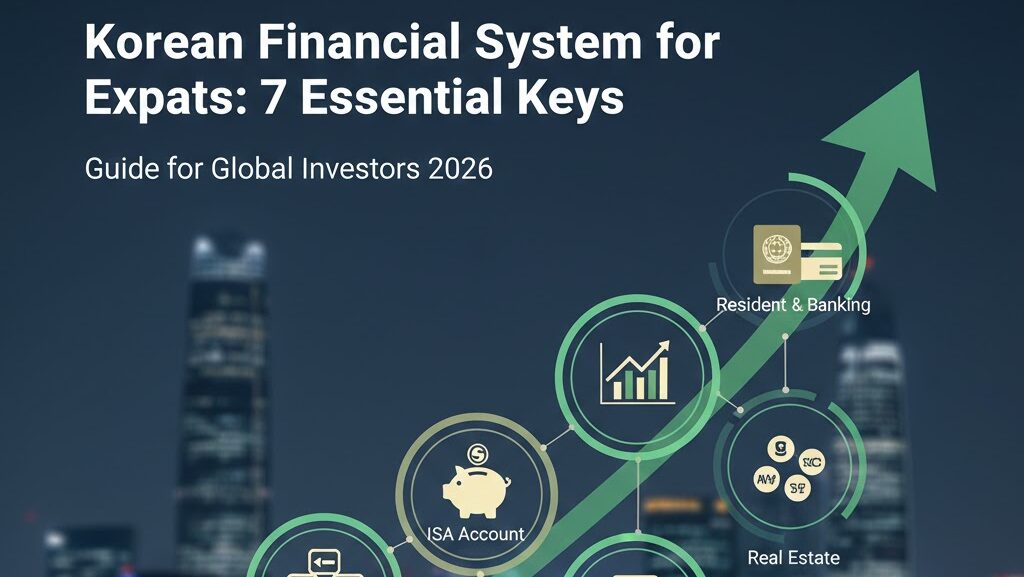
1. The Foundation: Resident Registration and Banking
Everything starts with your ARC (Alien Registration Card). Without it, your access to the Korean Financial System for Expats is severely limited. I remember my first visit to a local bank; without the right digital certificate (Joint Certificate), I couldn’t even perform a simple wire transfer.
2. The Power of the ISA (Individual Savings Account)
I personally use a Brokerage-type ISA (ISA중개형) to manage my investments. This account is a game-changer because it allows you to invest in stocks and ETFs while providing significant tax exemptions on your profits. In my experience, this is the single best tool for any expat looking to build long-term wealth in Korea.
Quick Summary Checklist
- [ ] Secure your Alien Registration Card (ARC).
- [ ] Open a Brokerage-type ISA for tax benefits.
- [ ] Set up a “Joint Certificate” or “Financial Certificate” for online banking.
- [ ] Register for a securities account to trade K-Stocks and ETFs.
3. Navigating the K-Stock Market (KOSPI & KOSDAQ)
The Korean stock market is dynamic and tech-heavy. I recently focused on the battery sector, specifically looking at solid-state battery and silicon anode technology. Understanding the difference between the KOSPI (large-cap) and KOSDAQ (tech/growth) is vital for your portfolio’s balance.
4. Understanding ETF Investing
If picking individual stocks feels risky, ETFs are your best friend. As I showed in my recent 323-share purchase of the SOL ETF, you can gain exposure to entire sectors with a single click. The Korean Financial System for Expats makes it easy to trade these through your smartphone app.
5. Digital Banking and “Pali-Pali” Culture
Efficiency is king in Korea. Most of my financial management is done via mobile apps during pre-market hours, such as checking “Before-Market” orders at 8:30 AM. You need to be comfortable with mobile interfaces to truly master the Korean Financial System for Expats.
6. Tax Obligations for Foreigners
Taxation can be tricky. Korea has global income tax requirements for residents who have lived here for more than 5 years out of the last 10. Always consult with a local tax office to ensure you are maximizing your deductions while staying compliant with the Korean Financial System for Expats.
7. Real Estate and Long-term Wealth
While I focus on stocks, many expats find success in the Jeonse or Wolse systems. Understanding how to secure a “Jeonse Loan” is a unique part of the Korean Financial System for Expats that can drastically lower your monthly living costs.
Step-by-Step Action Guide
- Visit a Major Bank: Go to a branch with English-speaking staff (like KEB Hana or Shinhan).
- Open an ISA: Explicitly ask for a “Brokerage-type ISA” (ISA중개형) to save on taxes.
- Install a Trading App: Use a reputable app like MTS (Mobile Trading System) to monitor your stocks.
- Start Small: Begin by purchasing 1-10 shares of a broad market ETF to get used to the interface.
FAQ / Special Tips
- Q: Can I trade in the US market from Korea?
- A: Yes! Most Korean brokerage apps allow you to trade NYSE and NASDAQ stocks, often with surprisingly low fees.
- Q: What is a “Joint Certificate” (공인인증서)?
- A: It is your digital signature. You cannot do serious banking or investing without it.
- Q: Is there a limit on how much I can invest?
- A: For the ISA, there is an annual contribution limit of 20 million KRW (up to 100 million total), but it offers the best tax breaks in the Korean Financial System for Expats.
Conclusion
Building wealth in South Korea is an exciting journey. By understanding the Korean Financial System for Expats, you are not just saving money; you are investing in your future in one of the world’s most innovative economies. I hope my personal experiences help you take that first step today!
Stay wealthy and healthy, Jay
If you enjoyed this post, you might also like: 5 Smart Ways to Use ISA Korea Investment for 2026 Wealth Growth