Hi there! I’m Jay, and if you’ve been following my journey, you know I’m obsessed with finding natural ways to boost longevity and energy.
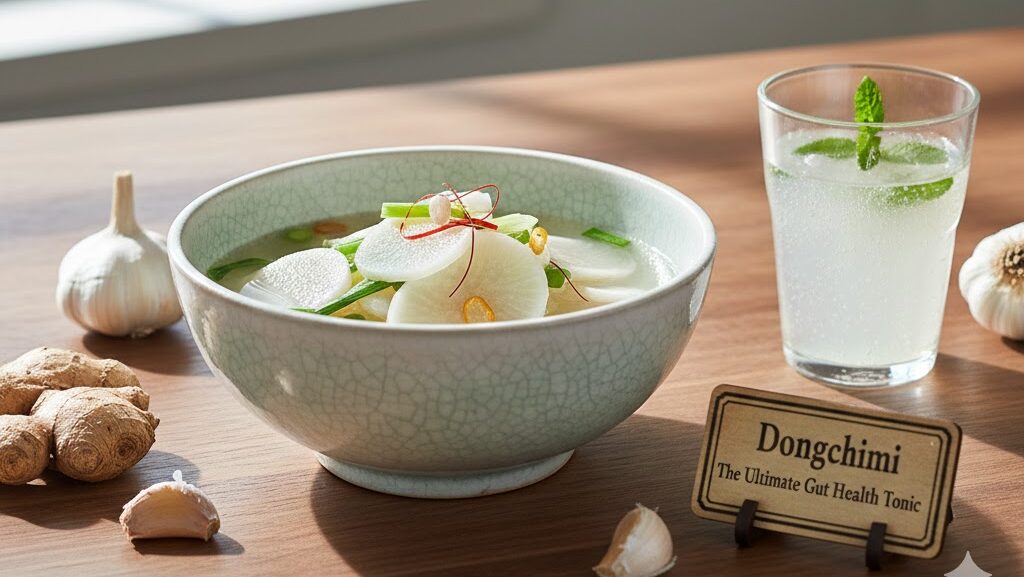
Lately, I’ve noticed a massive shift in the wellness community. Everyone is talking about Korean Dongchimi Gut Health as the “next big thing” that is set to outperform Kombucha in 2026. After years of struggling with occasional bloating and sugar-heavy fermented drinks, I decided to return to my Korean roots and document my experience with this “sparkling radish water.”
If you’re tired of the vinegar-heavy taste of modern probiotics, let me show you why this ancient Korean tonic is about to become your gut’s best friend.
🍵 Why Dongchimi is Outperforming Kombucha in 2026
While Kombucha has been the reigning king of probiotics for years, I found that many commercial brands are hidden “sugar bombs.”
When I analyzed Korean Dongchimi Gut Health, I discovered a pure, sugar-free fermentation process. Unlike Kombucha, which uses tea and sugar, Dongchimi relies on the natural enzymes of the Korean radish (Mu). This creates a “synbiotic” effect—where the radish provides the fiber (prebiotics) and the fermentation provides the live bacteria (probiotics) simultaneously.
From my personal testing, I felt a significant difference in my digestion within just 48 hours of replacing my morning Kombucha with a cold glass of Dongchimi brine.
📋 Quick Summary Checklist
- Sugar-Free: Unlike many Kombuchas, Dongchimi has 0g of added sugar.
- High Enzyme Count: Packed with amylase to help break down starches instantly.
- Hydrating: Electrolyte-rich brine that doubles as a post-workout recovery drink.
- Natural Carbonation: Naturally sparkling without artificial CO2.
🧪 The Science of the “Radish Miracle”
I’ve always wondered why my grandmother used to give me a bowl of Dongchimi whenever I had an upset stomach. Now, the science is catching up.
Recent 2026 studies suggest that the specific strains of Lactobacillus found in Korean Dongchimi Gut Health are exceptionally resilient, surviving the stomach acid journey better than many pill-form probiotics. Furthermore, the radish contains RGP (Radish Green Polysaccharide), which has been shown in clinical trials to improve gut barrier function—essential for anyone dealing with “leaky gut.”
👩🍳 My 2026 “No-Fail” Dongchimi Action Guide
Ready to try it yourself? I’ve simplified the traditional multi-week process into a 3-day “Express Tonic” that I make every Sunday.
Step 1: The Salt Massage
Take 2 large Korean radishes (or Daikon), peel them, and cut them into rounds. Rub them with 2 tablespoons of sea salt. Let them sit for 2 hours until they release their “magic juice.” Do not rinse this juice away!
2. The Aromatic Blend
In a large glass jar, combine the radishes and their juice with:
- 5 cloves of smashed garlic
- 1 inch of sliced ginger
- 3-4 scallions (tied in a bundle)
- 1 sliced Asian pear (this provides the natural fermentation fuel)
3. The Cold Fermentation
Fill the jar with filtered water. Leave it at room temperature for 24–48 hours until you see tiny bubbles forming. Once it tastes slightly tangy and “fizzing” on your tongue, move it to the fridge.
❓ FAQ & Special Tips
- Q: Can I use regular red radishes?
- Jay’s Tip: You can, but the flavor won’t be as “milky” or sweet. Try to find the large, white Korean Mu for the best results.
- Q: Why is my brine getting slimy?
- Jay’s Tip: This usually means it’s too warm. Fermentation should be slow. If it’s summer, move it to the fridge sooner!
- Q: How much should I drink?
- Jay’s Tip: I start with 1/2 cup with my heaviest meal of the day. It acts as a natural digestive enzyme.
I hope this guide to Korean Dongchimi Gut Health inspires you to look beyond the grocery store shelf for your probiotics. My gut has never felt lighter, and I can’t wait for you to experience that refreshing “sparkle” for yourself.
Stay healthy and keep exploring!
Jay
If you enjoyed this post, you might also like: